



If you’re a groyper or America First-aligned Republican, it hasn’t been a pleasant year for you. Not a great year. Regardless of how you feel about President Trump, his hold over the Republican Party has never been stronger, with his endorsed candidates winning 96 percent of primaries this year. Trump-endorsed candidates have dethroned entrenched Con, Inc. incumbents in Texas and Louisiana’s Senate races and Trump famously scalped Thomas Massie, the most vocal congressional opponent of his agenda, in May.
Some of Trump’s endorsements have caused controversy among the right, most notably Vivek Ramaswamy in the Ohio gubernatorial race and Byron Donalds in the Florida gubernatorial race. In those races, insurgent candidates rose up to challenge Trump’s anointed, specifically Casey Putsch in Ohio and James Fishback in Florida. Both lost in humiliating landslides. Putsch drew only 18 percent of the vote in the May primary, a loss of over 60 points, while Fishback performed even worse, winning 10 percent of the Florida Republican vote, running in third behind both Donalds and incumbent Lieutenant Governor Jay Collins. There’s really no way to spin their campaigns as anything but embarrassing failures given the weaknesses of Trump’s endorsees and the seeming strong support they enjoyed online.
This isn’t a dismissal of the issues they campaigned on, which resonate with many Americans, including young Americans. Opposition to unrestricted Indian immigration, data centers, and Israeli influence in American politics are all popular sentiments. But neither Putsch nor Fishback were able to turn these sentiments into electoral success. I spoke to several campaign volunteers who had worked on Putsch’s and Fishback’s campaigns and they painted an extremely bad picture of narcissism and disaster on the candidates’ part.
Why Putsch and Fishback Failed

After the Ohio gubernatorial primary, I had the opportunity to speak at length with George Roush, a Republican strategist who masterminded Casey Putsch’s campaign, including recruiting a launch team culled in part from Young Republicans groups, designing Putsch’s branding, recruiting Putsch’s campaign team, and formulating policy for Putsch’s election platform. Roush was opposed to Ramaswamy’s candidacy and had sought to recruit a challenger who would run on Christian values, exposing Ramaswamy’s corruption, and taking on popular issues like ending property taxes and curtailing zoning problems with data centers.
Early analytics showed that Putsch had a slim but real shot at defeating Ramaswamy. Roush lays the blame for the failure of the campaign on Putsch himself. In Roush’s telling, Putsch “wouldn’t call donors, wouldn’t go to campaign events, wouldn’t work on his own campaign, refused to read his own policy, [and] wouldn’t use the talking points that he asked to have prepared for him,” among other things. Putsch was unable to develop policy or talking points “beyond his own ‘globalist trojan horse’ line, which wasn’t particularly bright…and even if it was, he never explained why to the voters.”
In Roush’s assessment, despite Putsch being surrounded by experienced campaign volunteers, he refused to put any effort into his campaign beyond posting online and “repeatedly undermined his own staff on social media when they tried to get him to stop posting insane stuff.” Putsch failed to establish a ground game or any sort of normative campaign structure that would enable him to take his message to the voters he needed to win.
Putsch was also consistently abusive to his own staffers, creating a situation in which experienced people, tired of the way he was treating them, would quit, be replaced, and the new hires would then quit. Roush himself quit Putsch’s campaign in late February because “I listened to him scream at my staff twice in one week about 1. How he was too busy to read their stupid policy papers and 2. How they were all idiots compared to him because they told him not to post a picture flipping off the president and saying he’s going to break the law while sitting in an orange [L]amborghini.”
Jacob Tilley, one of Putsch’s campaign directors, also came forward after the Ohio primary with an account that corroborates many of Roush’s claims. Putsch told Tilley that “he had no intention of winning,” yet continued to collect donations from Ohioans desperate for an alternative to Ramaswamy. Tilley also further details Putsch’s narcissistic meltdowns, where he would scream at staffers about how he was “smarter than all of us” and we “didn’t have the experience he had.” Tilley noted that Southeast Ohio was where Putsch performed the strongest in voting, but this was due to the efforts of Tilley and his team and not Putsch himself.
I spoke to another Putsch campaign volunteer on condition of anonymity who stated that the campaign had tried to pivot away from the anti-Trump comments Putsch had been making, seeing them as poisonous to his electoral chances. They wrote an X post for Putsch where he praised Trump’s deportation policy and pledging to work with ICE if Putsch was elected governor. Groypers immediately became hostile, Putsch freaked out thinking this mattered, then he deleted the post and made his own follow-ups accusing his campaign of hijacking his account and he wasn’t actually pro-Trump.
I spoke to a volunteer for James Fishback recently who told me that when he joined, he was told that volunteers would not be doing any door-knocking. Instead, “we were to focus on spreading the word via social media instead.” The ex-volunteer also said that they “never got any further instructions other than to ‘talk about [F]ishback in local county/city groups.'” The ex-volunteer also revealed that Fishback had a revolving door on personnel: “The lead volunteer for the county, who was responsible for relaying info from the campaign to us on the ground, quit because he saw [F]ishback for who he was: a grifter. I quit along with him as I’d seen enough myself.”
The volunteer also revealed that Fishback’s campaign constantly squandered volunteer resources. Shortly after joining, the leader asked volunteers if they “could make icons for county specific campaign social media pages.” The volunteer’s spouse spent a day making an icon only for the Fishback to use it for only a week “on dead accounts” and then remove it. The volunteer provided the icon to me as proof of the story.
The unfortunate picture is that both Putsch and Fishback were grifters who were not interested in winning and simply sought to exploit the talents of their staffers and volunteers. It’s unfortunate that many young Americans were fooled by them.
Lessons from History: The Story of Paul Nehlen
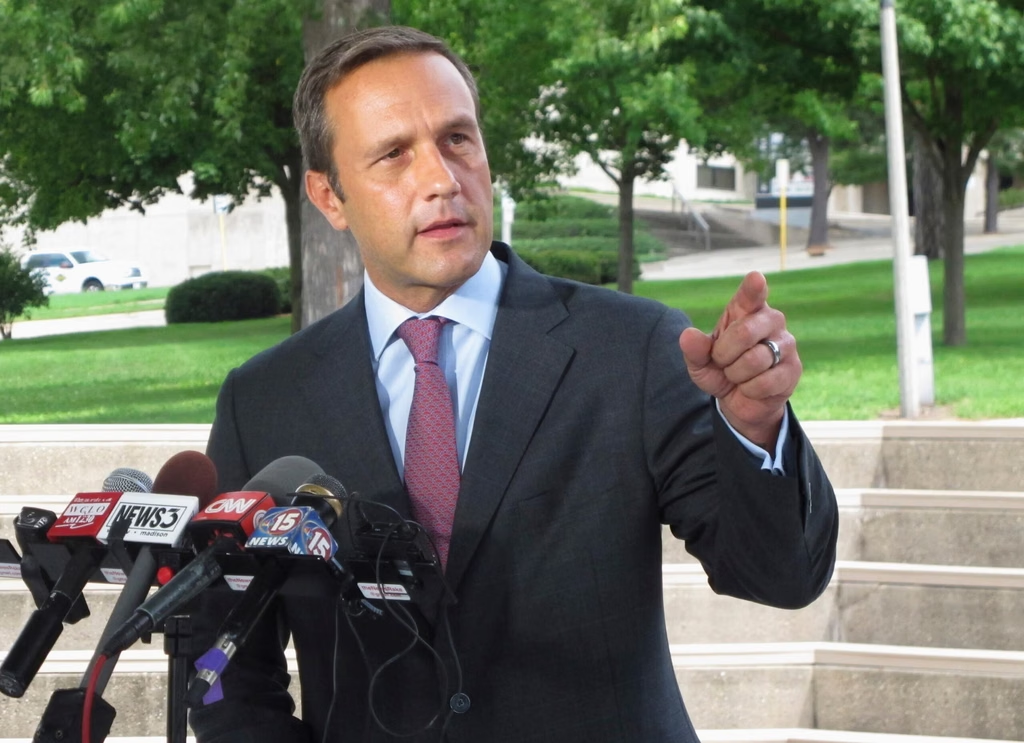
A common thread in the Putsch and Fishback stories is that both were obsessed with online clout to the exclusion of serious campaigning and policy. This is not new. Longtime activists on the right might remember the sorry case of Paul Nehlen, a based candidate who fell victim to the algorithm.
Nehlen was a candidate from Wisconsin who, in 2016, challenged then-House Speaker Paul Ryan in the Republican primary, citing Ryan’s pro-immigration, anti-Trump, Chamber of Commerce “conservatism.” In the campaign, Nehlen was endorsed by Breitbart, Sarah Palin, Ann Coulter, and other mainstream right-wing figures and organizations. He emphasized that he was a MAGA supporter and if elected, would support Trump’s agenda of deportations, tariffs, and building that big beautiful border wall. Nehlen lost by a significant margin, garnering only 16 percent of the vote to Ryan’s 84 percent, but he had a real chance to win in 2018 after Ryan announced his retirement from Congress.
In the wave of post-election bans from Twitter, Nehlen and many of us wound up on Gab, an alt-tech site that sold itself as a censorship-free, free speech alternative to Big Tech. In 2017, Gab was progressively colonized by the most extreme, anti-social elements of what was then the “alt-right,” and Nehlen, in pursuit of approval and upvotes, became an anti-Trump, Israel-obsessed crank who constantly feuded with people on the right. This culminated in early 2018 when, in collaboration with “Crying Nazi” Christopher Cantwell, Nehlen doxed noted pundit Douglass Mackey (then going as “Ricky Vaughn”), accusing Mackey of having GOP connections and trying to “control” and “neuter” Nehlen. This “control” came in the form of Mackey trying to help Nehlen win the Republican nomination in the 2018 midterms.
Nehlen’s actions not only caused serious harm to Mackey’s personal and professional life, they put a chilling effect on what was left of the alt-right, which had already been grievously wounded by the disaster of the Unite the Right rally in Charlottesville in 2017. Many intelligent people left the alt-right out of fear that they would be doxed and have their lives ruined, not by the left, but by their ostensible “allies.” It’s arguable that Nehlen’s actions helped lead to Mackey’s arrest in 2021 on bogus charges of election interference, charges that were politically motivated and which were thankfully overturned.
And what did pivoting into overt neo-Nazism do for Nehlen? In the 2018 Republican primary in Ryan’s district, Nehlen performed even worse than he did in 2016, winning only 11 percent of the vote and coming in third. He’s since vanished from the Internet.
How to Win as an Insurgent America First Candidate

There are two distinct strains of cope resulting from the failures of campaigns like Putsch’s and Fishback’s. The first is that “they never had a chance to win.” Testimonials from Putsch’s own campaign volunteers put the lie to that notion. The second is that their embarrassing underperformances are somehow indicative of a growing movement that will eventually take over the GOP. The problem is that groyper-aligned candidates have seen their electoral performances get worse over time. In 2020, Lauren Witzke, a close ally of Nick Fuentes and the director of his America First Foundation, won the Republican Senate nomination in Delaware running against an establishment candidate who had the backing of the state GOP. Putsch and Fishback both lost their respective primaries, with Fishback getting fewer votes then a candidate who barely had any online footprint.
I keep getting told that “America First is the future,” but Nick Fuentes has been a public figure for ten years at this point and is closer to 30 than he is to 20. To paraphrase Razorfist, shouldn’t the future be the present by now?
Roush told me that despite Putsch’s loss, his organization has built an infrastructure that is capable of running insurgent, nationalist candidates across Ohio. Putsch’s and Fishback’s failures stem in part from their personal defects; Putsch’s arrogance and narcissism are well-documented, while Fishback is mired in multiple lawsuits and scandals and is perceived by many as a grifter. But America First candidates can win, and here’s how:
- Don’t attack Trump. I don’t care how disappointed you are with Trump, how many blackpills that Tucker Carlson and Nick Fuentes have fed you. Donald Trump is the Republican Party. He runs the show. You need his blessing or at least his neutrality to get anywhere. The majority of Republicans—the people you need to win over—support Trump. There is no constituency for being Based and Anti-Trump; it’s a less popular position than Bush-style compassionate conservatism. The few candidates this cycle who have defeated Trump endorsees, such as Rick Jackson in Georgia and Charlie Hatcher in Tennessee, did so by positioning themselves as Trump allies.
- Get off social media. If only X users could vote, Putsch and Fishback would have won in landslides. But the heady days of 2016 or even 2024 are over. As Freedom Alternative pointed out in his post-mortem on the Hungarian election, X and other social media sites are so overrun with bots and AI slop that they do not represent public opinion anymore. Stunting on the hoes online cannot help, it can only hurt. Ramaswamy himself realized how damaging his X posts were to his political ambitions, so he got off social media to focus on retail campaigning. This is why he won.
- Stop talking about the Jews. Israel, pro- or anti-, is not an important issue for the kinds of voters you need to win a Republican primary. They want to hear about jobs, inflation, crime; meat and potato issues. Not only that, a governor’s ability to influence Israel, Iran etc. is fuck all. Mouthing off about how much you hate Israel cannot help in a Republican primary. Again, it can only hurt, because you look like a deranged moron to the people who actually vote and you take away valuable space that could be used for important issues, issues where you shine.
- Don’t rely on young voters. Youth have always been the lowest-propensity voters, the least likely to turn out to the polls. Boomers and GenXers, being old, are the only age demographics that can be relied on to actually cast ballots. The severe population imbalance, where zoomers are outnumbered by not only boomers but millennials, makes Fishback’s strategy of lasering on the youth vote even more foolish. Should you try to court young voters? Sure. But you should not make them the centerpiece of your strategy, because they will always disappoint you.
Brandon Herrera is an example of how an influencer can transition from the Internet to public office. Herrera, like Putsch, is a YouTuber. Unlike Putsch, Herrera won his primary and is almost certainly going to be elected to the House. What’s the difference? Herrera didn’t “campaign” by camping out on Twitter to stunt on them Jewish hoes. He hit the campaign trail, made friends and allies in local GOP organizations, focused his messaging on how he wanted to help his constituents and what he planned to do in office. Herrera also didn’t turn on Trump and now he has Trump’s endorsement. Learn from Brandon Herrera.
The crown is lying in the gutter. It’s time to lean over and pick it up.